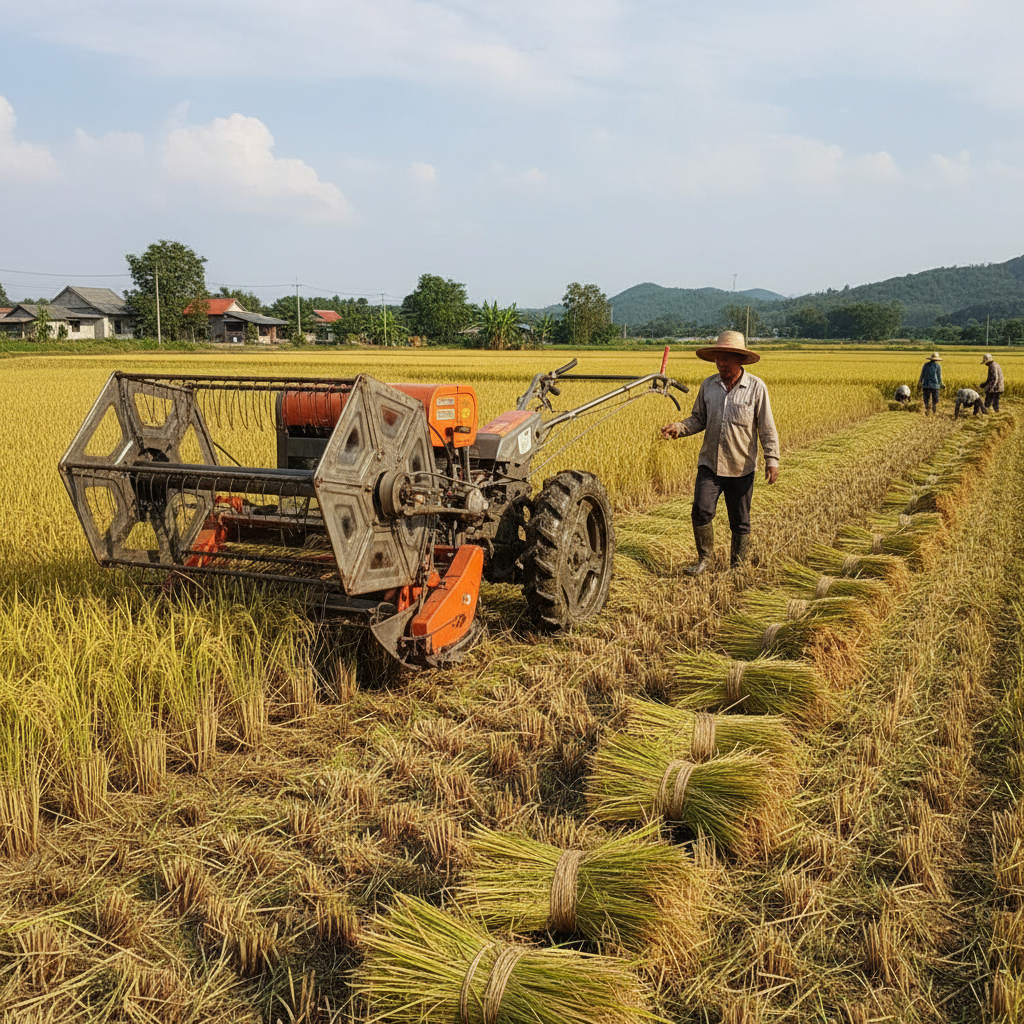
Small-scale farming operations often face a critical decision when moving from manual labor to mechanization: finding a balance between operational capacity and capital expenditure. The search for a competitive hand reaper price usually signals a transition toward semi-automated harvesting to reduce labor costs and time.
While traditional hand-harvesting is precise, it is increasingly unsustainable due to rising labor shortages and the need for faster turnaround times during peak harvest windows. The shift toward compact, self-propelled, or attachment-based reapers allows farmers to maintain the agility of manual work while achieving the throughput of industrial machinery.
Evaluating these tools requires more than just comparing price tags; it involves understanding the total cost of ownership, the specific crop requirements, and the efficiency gains provided by integrated systems like those found in modern small combine harvesters.


Historically, grain harvesting in hilly or small-plot regions relied exclusively on hand tools. However, the economic pressure to increase yield per hour has pushed the market toward specialized mechanical reapers. The primary driver is the reduction of "cumbersome steps"—the transition from cutting to gathering, then threshing and cleaning.
Modern mechanical solutions, such as the self-propelled reaper series, offer a middle ground. They provide the precision of a hand-cut harvest but at a fraction of the time. This evolution is not just about speed, but about reducing the physical toll on farmers and minimizing crop loss during the handling process.
The efficiency of a small combine harvester lies in its integration of multiple stages into a single workflow. These machines typically utilize a crawler self-propelled mechanism, allowing them to navigate soft or uneven soils without compacting the earth excessively. The core operating principle involves a reaper head that cuts the crop, a conveyor that transports it to a thresher, and a cleaning system that separates the grain from the chaff.
From a design perspective, the use of double cutters is a significant technical advantage. This configuration ensures a low cutting height, which is essential for maximizing yield and simplifying the subsequent plowing process. Power is generally supplied by diesel engines or high-torque motors, ensuring that the machine can handle dense crop stands without stalling.
Furthermore, the mechanical structure is optimized for flexibility. By keeping the chassis compact and the weight low, these machines can be easily transferred between fragmented fields—a common challenge in mountainous or plain rice-producing areas. This agility makes them far more practical than large-scale industrial combines for specialized farming.
When assessing the value of mechanized harvesting, one must look beyond the initial purchase price. The real efficiency is found in the "simultaneous operation" capability—where harvesting, threshing, cleaning, and stalk crushing occur in one pass. This removes the need for separate machinery and multiple trips across the field.
The transition to integrated harvesting reduces fuel consumption and labor hours significantly, leading to a shorter payback period for the investment compared to traditional multi-step reaping methods.
Hebei Niuboshi Machinery Equipment Co., Ltd. has focused on these efficiencies by collaborating with institutions like the Agricultural University of Hebei. By refining the mechanical synchronization of the reaper cutting head series, they have reduced the impurity rate of the gathered grain, ensuring that the output is market-ready with minimal post-processing.
To understand the impact of mechanization, we can look at a relative value index. This index compares the efficiency and cost-effectiveness of different harvesting methods across key metrics such as labor reduction, time savings, and purity of the final product.
While a manual reaper has the lowest entry cost, the operational cost over a full season is the highest. In contrast, a small combine harvester represents a higher initial investment but offers the highest value in terms of operational throughput and energy saving.
The versatility of compact reaping machinery allows it to be deployed across a wide array of grain types. While traditionally used for rice and wheat, the current generation of equipment is capable of handling soybeans, highland barley, and even high-stalk crops like sorghum or sesame. This flexibility is critical for farmers who rotate crops to maintain soil health.
In practical settings, the choice of machine depends on the terrain. For example, rice fields in mountainous areas require the lightweight, low-pressure tracks of a crawler-type harvester to prevent sinking. Conversely, plain wheat fields can benefit from the faster travel speeds of the self-propelled reaper series. This ensures that regardless of the geography, the loss rate remains low and the purity of the grain remains high.
The trajectory of agricultural machinery is moving toward extreme precision and reduced environmental impact. We are seeing a shift toward more energy-efficient power sources and smarter cutting mechanisms that can adjust in real-time to crop density. This reduces fuel consumption and minimizes the waste of biomass.
There is also a growing demand for customization. As farmers deal with unique crop varieties, such as Chinese herbal medicines or specialized pepper varieties, the need for bespoke cutting heads has increased. This requires manufacturers to move away from rigid mass production and toward modular designs that can be adapted to specific agricultural needs.
Ultimately, the goal is to achieve "industrial efficiency on a boutique scale." The ability to process a small field with the same precision and cost-per-ton as a massive commercial farm will be the defining characteristic of the next generation of reaping equipment.
Selecting the right equipment requires a rigorous comparison of technical specifications against actual field conditions. A common mistake is over-investing in capacity that the land cannot support, or under-investing in a tool that requires too much manual intervention, effectively negating the benefits of mechanization.
Key evaluation factors include the "loss rate" (the percentage of grain left in the field) and the "impurity rate" (the amount of chaff mixed with the grain). A lower loss rate directly increases the net profit per acre, making it a more critical metric than the initial hand reaper price.
The following framework provides a relative suitability assessment for different harvesting solutions based on operational needs and environmental constraints.
| Solution Type | Terrain Suitability | Labor Requirement | Investment Level |
|---|---|---|---|
| Manual Reaping | All Terrains | Very High | Low |
| Reaper Cutting Head | Plains/Flat | Moderate | Medium |
| Self-Propelled Reaper | Mixed Terrain | Low | Medium-High |
| Small Combine | Mountain/Plain | Very Low | High |
| Disc Mower | Orchards/Roads | Low | Medium |
| Customized Model | Specialized Plots | Low | Variable |
A standard reaper typically only cuts and gathers the crop, leaving the threshing and cleaning for a separate process or machine. A small combine harvester integrates these steps—harvesting, threshing, cleaning, and often stalk crushing—into a single operation. This integration significantly reduces the labor hours required and minimizes the risk of grain loss during transport between different processing stages.
Terrain dictates the mobility requirements. For mountainous or soft-soil rice fields, crawler-type self-propelled machines are preferred because they distribute weight more evenly, preventing the machine from sinking. In contrast, plain wheat or soybean fields can be handled by wheeled reaper series or tractor-mounted cutting tables, which offer higher travel speeds and faster coverage per hour.
Most compact reapers are designed for traditional grains such as rice, wheat, and soybeans. However, advanced models can be adapted for highland barley and high-stalk crops like sorghum or sesame. The suitability depends largely on the reaper head design; modular systems allow for different cutting heights and widths to accommodate various crop architectures.
A low cutting height, often achieved through double cutter mechanisms, ensures that the maximum amount of the grain head is harvested, reducing waste. More importantly, it leaves the remaining stalks short and uniform, which makes the subsequent plowing and soil preparation process much easier and more fuel-efficient for the tractor.
ROI should be calculated by comparing the cost of the machine against the total savings in labor wages and the increase in yield due to lower loss rates. A machine with a "preferential price" but high impurity rates may actually cost more in the long run due to the need for additional cleaning. The most valuable machines are those that offer a short payback period through high operational efficiency.
Modern compact harvesters are designed specifically for ease of use. They typically require minimal technical training, featuring intuitive controls that allow farmers to operate them without extensive support. The goal of companies like Hebei Niuboshi is to create "plug-and-play" agricultural tools that transition the farmer from manual labor to mechanization with a very shallow learning curve.
The transition from hand harvesting to mechanized reaping is a strategic move toward agricultural sustainability. By integrating cutting, threshing, and cleaning into a single workflow, farmers can drastically reduce their dependence on scarce labor while increasing the purity and volume of their harvest.
Whether investing in a simple reaper head or a full small combine harvester, the priority must remain on a balance of terrain suitability, crop compatibility, and long-term operational efficiency. As technology continues to refine, the ability to customize these tools for specific regional needs will further empower small-scale farmers to compete in a global market.